
Last Updated: October 23, 2026
Quick Summary
To measure walls for wallpaper, measure the height at three points on each wall from floor to ceiling, measure the width from corner to corner, subtract square footage of doors and windows, then multiply height by width to calculate total square footage needed for your order.
- Measure wall height at three points (left, middle, right) and use the tallest measurement to account for uneven walls.
- Subtract the square footage of doors, windows, and built-in features to avoid ordering excess wallpaper.
- A wallpaper calculator converts your square footage into the number of rolls needed by accounting for pattern repeats and standard roll sizes.
- Always round up your final roll count and add one extra roll to cover installation mistakes and future repairs.
- Write down every measurement immediately on a worksheet rather than relying on memory to prevent calculation errors.
Table of Contents
- Why Accurate Measurements Matter Before You Order
- What You’ll Need to Measure Walls for Wallpaper
- Step-by-Step: How to Measure Walls for Wallpaper
- Understanding Wallpaper Pattern Repeat Calculation
- Using a Wallpaper Calculator to Determine Yardage
- How Many Wallpaper Rolls Do I Need: The Formula
- Using a Wallpaper Measurement Worksheet
- Common Mistakes to Avoid When Measuring
- Frequently Asked Questions
Why Accurate Measurements Matter Before You Order
Getting the right amount of wallpaper starts with precise measurements. Order too little and you’ll face delays waiting for more. Order too much and you’re stuck with expensive waste. At Factory Direct Wallpaper, we’ve helped thousands of homeowners and designers avoid both mistakes by measuring correctly the first time.
The stakes are real. A single miscalculation can throw off your entire budget and timeline. Wallpaper patterns don’t always match perfectly across rolls, especially with larger repeats. Ordering extra “just in case” costs money you don’t need to spend. But skimping on measurements creates gaps in coverage that ruin the final look.
This guide walks you through every step of measuring walls for wallpaper. You’ll learn the exact process we recommend, common pitfalls to avoid, and how to use calculators to double-check your work. By the end, you’ll know precisely how much wallpaper to order.
What You’ll Need to Measure Walls for Wallpaper
Before you start, gather these simple tools:
- Tape measure (25-foot minimum for larger walls)
- Notepad and pen (or a notes app on your phone)
- Ladder or step stool (to reach the top of walls safely)
- Calculator (for math, or use your phone)
- Wallpaper calculator (optional but recommended)
You don’t need anything fancy. A basic tape measure works fine. Write down every measurement as you go. Don’t rely on memory, numbers blur together fast when you’re working on multiple walls.
Consider taking photos of each wall with measurements written on paper held in front of it. This backup helps if you need to reference measurements later or call Factory Direct Wallpaper’s 24/7 customer support team with questions.
Step-by-Step: How to Measure Walls for Wallpaper
Step 1: Measure Wall Height
Start at the top of the wall where it meets the ceiling. Drop your tape measure straight down to the floor or baseboard. Write this number down.
Measure from floor to ceiling, not from the top of the baseboard. Wallpaper typically covers the wall surface, and installers account for trim separately.
Take measurements at three points on each wall: left side, middle, and right side. Walls are rarely perfectly level. If heights differ, use the tallest measurement. This gives you coverage for the entire wall.
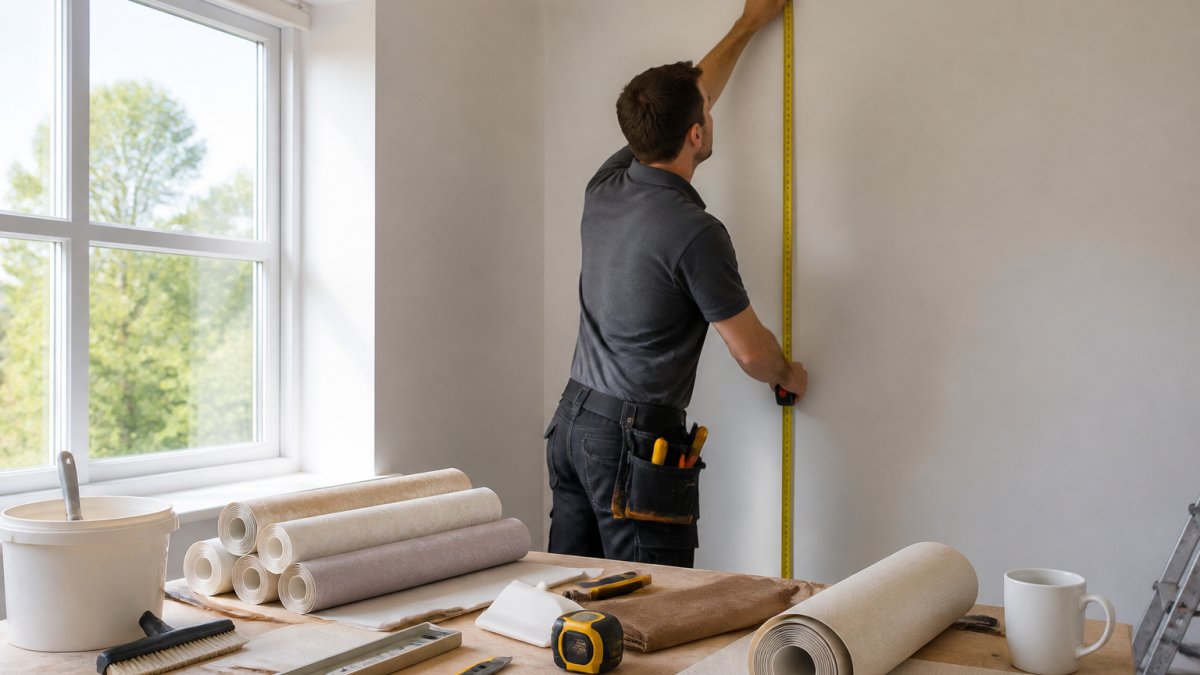
Consistent vertical measurements ensure a seamless pattern match across the entire room, though additional precision becomes necessary when measuring alcove spaces to account for their unique architectural depth.
Step 2: Measure Wall Width
Now measure the width of each wall from corner to corner. Start at one corner and extend your tape measure horizontally across to the opposite corner. Write this number down.
Again, take multiple measurements if the wall isn’t perfectly straight. Use the longest measurement you get. This ensures your wallpaper covers the full width.
For walls with unusual shapes (angled ceilings, sloped walls), measure the width at the top and bottom separately. You’ll need both numbers to calculate coverage accurately.
Step 3: Account for Doors and Windows
This step saves money. You don’t need wallpaper for areas covered by doors, windows, or built-in features.
Measure the height and width of each door and window opening. Multiply height by width to get the square footage of each opening. Add all openings together.
For doors, measure from the floor to the top of the door frame. For windows, measure from the sill to the top of the window frame. Include any trim or molding that won’t be papered.
Common areas to subtract:
- Exterior doors
- Interior doorways
- Large windows
- Built-in shelving
- Fireplaces
- Closet openings
Don’t subtract small openings like light switches or outlets. Wallpaper installers work around these easily.
Step 4: Calculate Total Square Footage
Here’s the math:
- Multiply wall height by wall width for each wall
- Add all wall areas together
- Subtract the square footage of doors and windows
- This is your total square footage
Example:
- Wall 1: 10 feet tall × 12 feet wide = 120 sq ft
- Wall 2: 10 feet tall × 10 feet wide = 100 sq ft
- Wall 3: 10 feet tall × 12 feet wide = 120 sq ft
- Wall 4: 10 feet tall × 10 feet wide = 100 sq ft
- Total: 440 sq ft
- Minus one door (3 ft × 7 ft = 21 sq ft): 440 − 21 = 419 sq ft
Round up to 420 square feet for safety.
Understanding Wallpaper Pattern Repeat Calculation
Wallpaper patterns repeat at regular intervals. A pattern repeat is the vertical distance before the design repeats itself. This matters because installers must align patterns between strips, which uses extra material.
Small repeats (under 6 inches) use minimal extra wallpaper. Large repeats (12 inches or more) use significantly more. This is why patterned wallpaper often requires more yardage than solid designs.
When you measure walls for wallpaper, knowing the pattern repeat helps you order the right amount. Factory Direct Wallpaper includes pattern repeat information with every product. Check this number before calculating your final order.
Installers account for pattern matching by cutting strips longer than needed. The waste adds up across a room. This is why a room with a 24-inch repeat needs more wallpaper than the same room with a 6-inch repeat.
Using a Wallpaper Calculator to Determine Yardage
A wallpaper calculator converts your square footage measurement into the number of rolls or yards you need. This tool accounts for pattern repeats and standard roll sizes automatically.
Most wallpaper calculators work the same way:
- Enter your total square footage
- Enter the pattern repeat (in inches)
- Select your roll size (single roll, double roll, or by the yard)
- The calculator shows how many rolls you need
Many manufacturers provide free calculators on their websites. Factory Direct Wallpaper customers can use any standard calculator, the math is the same across the industry.
Add one extra roll to your final number. This covers mistakes during installation, future repairs, or pattern matching issues. One extra roll costs far less than ordering more later.
How Many Wallpaper Rolls Do I Need: The Formula
Standard rolls vary in size. Most common in the United States:
- Single roll: covers approximately 28-30 square feet
- Double roll: covers approximately 56-60 square feet
- By the yard: typically 27 inches wide, covers about 27 square feet per yard
To find how many rolls you need, divide your total square footage by the roll size.
Example with double rolls:
- 420 square feet ÷ 57 square feet per roll = 7.4 rolls
- Round up to 8 rolls
- Add 1 extra roll for mistakes = 9 double rolls total
This formula works for any roll size. The key is knowing your square footage and the coverage per roll. Your wallpaper product page lists this information clearly.
Different patterns require different amounts. A large floral repeat uses more than a small geometric pattern. Always check the product details before ordering. Factory Direct Wallpaper lists yardage requirements for every pattern.
Order from the same dye lot whenever possible. Wallpaper from different production batches may have slight color variations that show between rolls. Most manufacturers print the dye lot number on the roll label.
Using a Wallpaper Measurement Worksheet
A measurement worksheet keeps you organized and prevents errors. Print one or create your own using a simple table.
Your worksheet should include:
| Wall | Height (ft) | Width (ft) | Square Footage | Doors/Windows | Adjusted Sq Ft |
|---|---|---|---|---|---|
| Living Room – Wall 1 | 10 | 12 | 120 | 0 | 120 |
| Living Room – Wall 2 | 10 | 10 | 100 | 21 | 79 |
| Living Room – Wall 3 | 10 | 12 | 120 | 0 | 120 |
| Living Room – Wall 4 | 10 | 10 | 100 | 0 | 100 |
| TOTAL | 419 |
Write down every measurement as you take it. This prevents the “Did I measure that wall?” confusion later. Use the worksheet to double-check your math before ordering.
Take photos of your worksheet. Keep them on your phone for reference. If you call Factory Direct Wallpaper’s customer support team with questions, you’ll have all your numbers ready.
Common Mistakes to Avoid When Measuring
Measuring from the wrong starting point. Start at the floor or baseboard, not partway up the wall. Wallpaper installers need full coverage from bottom to top.
Forgetting to measure multiple points. Walls aren’t always level or straight. Three measurements per wall (left, middle, right) catches these variations.
Ignoring pattern repeats. A 24-inch repeat uses much more wallpaper than a 2-inch repeat. Check this before calculating your order.
Not subtracting window and door openings. You can subtract these areas, but many homeowners don’t. It’s extra work for a small savings on one or two rolls.
Rounding down instead of up. Always round up. It’s better to have one extra roll than to run short mid-installation.
Using old measurements. Measure fresh for each project. Don’t assume a guest bedroom is the same size as the master bedroom.
Forgetting to add extra for mistakes. One extra roll covers installation errors, future repairs, or pattern matching problems. Budget for it.
Never measure alone if you’re using a tall ladder. Have someone hold the ladder steady. Falls from ladders cause serious injuries every year. Safety comes before saving time.
Trusting your memory instead of writing things down. Write every number down immediately. Numbers blend together when you’re juggling multiple walls and rooms.
Measuring too quickly. Take your time. Slow, careful measurements prevent expensive ordering mistakes. Rushing saves minutes but costs dollars.
Measuring walls for wallpaper accurately sets up your entire project for success. Once you have your measurements confirmed, browse our selection of designer wallpapers at factory closeout prices and get started on your room transformation today.
Frequently Asked Questions
Do you subtract doors and windows when measuring for wallpaper?
Yes, subtract the square footage of doors and windows from your total wall measurement. For a standard door (approximately 20 square feet) or window (roughly 10-15 square feet), deduct these areas. However, if you’re working with a bold pattern or want extra for pattern matching, you may choose to add back a small buffer. Most professionals subtract doors and windows to avoid over-ordering, but first-time installers often order 10% extra as insurance.
How does wallpaper pattern repeat affect how much I need?
Pattern repeat is the vertical distance before a design repeats on the roll. A large repeat (12-24 inches) requires more waste during installation because each strip must be matched to the pattern above it. For example, a 24-inch repeat wastes more material than a 0-inch repeat (solid color). When calculating yardage, add the repeat measurement to your wall height to account for this waste. A wallpaper calculator automatically factors this in, but manual calculations must include it to avoid ordering too little.
What measurements do I need to use a wallpaper calculator?
You need three key measurements: wall height (floor to ceiling), wall width, and the pattern repeat distance (found on the wallpaper sample or product listing). You’ll also need the width of the wallpaper roll, typically 27 inches or 54 inches. If your room has multiple walls, measure each separately or add them together if they’re the same height. A wallpaper calculator combines these to determine how many rolls you need, accounting for pattern matching and waste automatically.
Should I measure wallpaper in feet or inches?
Measure in feet for overall dimensions (wall height and width), then convert to inches when calculating pattern repeats or using a wallpaper calculator that requires inch-based input. Most wallpaper rolls are labeled in inches (27-inch or 54-inch widths), and pattern repeats are always given in inches. Converting everything to a single unit prevents calculation errors. Many online calculators accept both feet and inches, so check the tool’s requirements before entering your measurements.
