

Last Updated: November 3, 2026
Quick Summary
Effective wallpaper selection starts with the room, not the pattern: match the wallcovering to how the space is used, read its light at morning, midday and evening, and test samples on the actual wall before committing. Then scale the pattern to the room, choose a moisture-tolerant material for Chattanooga humidity, and measure carefully so you order the right rolls from one dye lot.
- High-traffic spaces like mudrooms, kitchens and kids’ rooms need a washable, scrubbable surface.
- Vinyl-coated and solid vinyl are the most moisture-tolerant options for kitchens, bathrooms and laundry rooms.
- Peel-and-stick is the least forgiving choice in Chattanooga’s humid months; avoid it in bathrooms.
- Order all rolls for a room in a single order so they come from the same dye lot.
- Buy one extra roll for mistakes and future repairs before you order.
Table of Contents
- Start With the Room, Not the Pattern
- Test Samples in Your Own Light and Live With Them
- Scale Patterns and Colors to the Space
- Best Wallpaper for Small Rooms: Fewer, Larger Moves
- Pick a Material That Survives Chattanooga Humidity
- How to Measure a Room for Wallpaper Without Wasting Rolls
- Wallpaper Mistakes to Avoid Before You Order
- Order Your Samples and Lock In Your Wallpaper Selection
- Frequently Asked Questions
Start With the Room, Not the Pattern
The biggest mistake in wallpaper selection starts before you ever open a catalog. Most people fall for a pattern first, then try to force it into a room it doesn’t fit. Homes vary widely, from century-old bungalows to new builds, and each one asks something different of a wallcovering. So before you pick a design, read the room. What happens in it? How does light hit it? How much traffic does it take? Those answers narrow your choices faster than any style quiz. Reading the room before choosing a pattern also helps each wallcovering support a cohesive home design rather than compete with the rest of the space.
Match the Wallcovering to How the Room Gets Used
A hallway and a guest bath are not the same job. High-traffic spaces like mudrooms, kitchens, and kids’ rooms need a washable surface you can wipe down. Quiet rooms, like a primary bedroom or a formal dining room, can handle a more delicate paper. Ask yourself two questions: who touches this wall, and how often? If the answer is “everyone, constantly,” lean toward durable and scrubbable. If it’s “almost no one,” you have room to play with texture and finer materials. Getting this right early saves you from redoing a wall in two years.
Read the Light Before You Read the Catalog
Light changes everything about how a pattern reads. A north-facing room gets cool, even light all day, so warm colors help it feel less chilly. A south-facing room gets strong, shifting sun that can make bright colors glow and dark ones look flat. Watch your room at three times: morning, midday, and evening. Note where shadows fall and how the wall looks under each. That window-facing wall you’re eyeing may look completely different at 7 p.m. than it did at noon.
Test Samples in Your Own Light and Live With Them
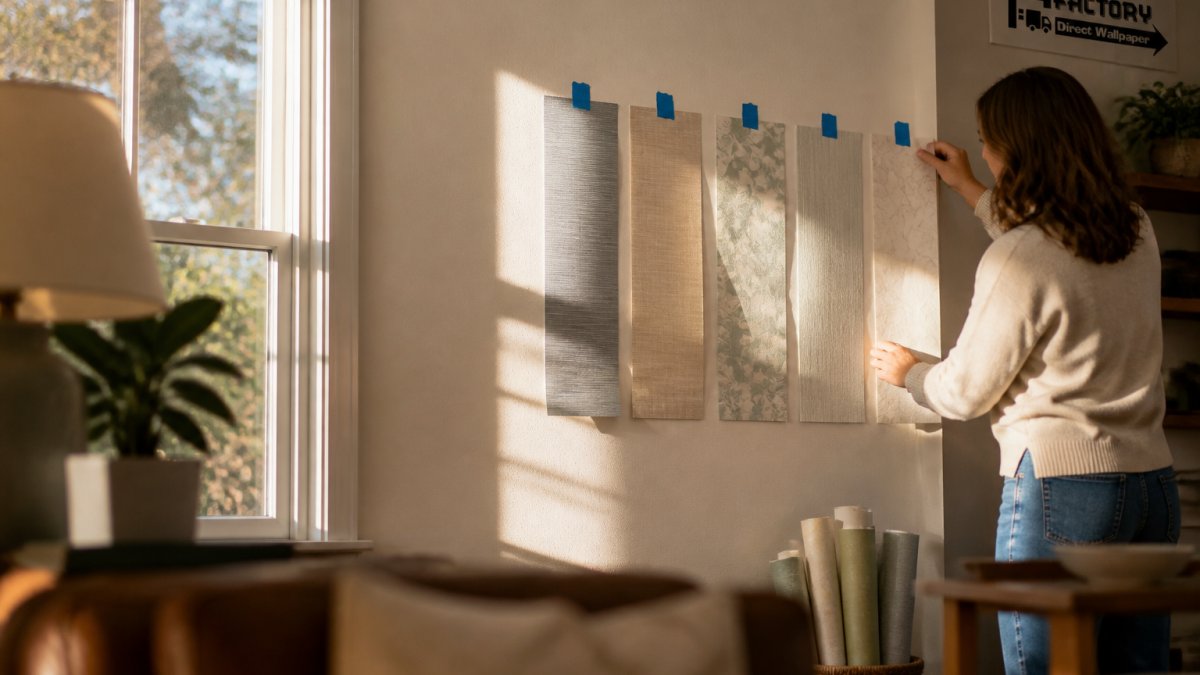
Order samples. Tape them to the actual wall. This is the step people skip, and it’s the one that saves the most regret. A pattern that sings online can turn muddy in your living room. A color that looks bold in a photo can read as gray on your wall. For more guidance on narrowing down patterns once you’ve seen them in place, our tips for choosing wallpaper patterns break down how to match a design to a room’s character.
Scale Patterns and Colors to the Space
Pattern scale does more to a room than color does. A large-scale print on a small wall can feel cramped. A tiny busy print on a big wall can look like static from across the room. As a rule, bigger rooms carry bigger patterns, and small rooms do better with medium or larger repeats that don’t overwhelm. Color works the same way. Light colors open a space; deep colors add coziness and drama. Pick your scale first, then your palette. That order keeps you from falling for a bold print that’s simply the wrong size for the wall.
Best Wallpaper for Small Rooms: Fewer, Larger Moves
Small rooms reward restraint. The best wallpaper for small rooms leans on fewer, larger moves: one strong accent wall, a larger-scale pattern, or a light color that reflects light back into the space. Busy all-over patterns in tight rooms make the walls feel closer. Instead, pick a design with breathing room. A soft geometric or a wide stripe can stretch a wall visually. If you’re working with a compact Chattanooga bedroom or bath, our guide to the best wallpaper for small rooms in Chattanooga goes deeper on patterns and colors that make tight spaces feel larger.
Pick a Material That Survives Chattanooga Humidity
Chattanooga’s humid summers can push indoor moisture up, especially in older homes without a whole-house dehumidifier. That matters because wallpaper failures in this climate are usually adhesion failures, not pattern failures. The paper lifts at seams, bubbles near exterior walls, or grows mildew behind the backing when moisture gets trapped.
Here is how the main material families hold up locally:
- Vinyl-coated and solid vinyl. The most moisture-tolerant option for kitchens, bathrooms, laundry rooms, and mudrooms. The vinyl surface wipes clean and resists the steam that builds up around showers and ranges. A fabric-backed vinyl is often a sturdier choice than a paper-backed vinyl in a steamy bath.
- Peel-and-stick (self-adhesive). Fine for renters and quick accent walls in bedrooms or home offices, but it is the least forgiving in Chattanooga’s humid months. If the wall is not fully cured, primed, and dust-free, the adhesive can release at edges and corners, especially on exterior walls that swing in temperature. Avoid it in bathrooms and above stoves.
- Traditional paper and grasscloth. Beautiful in a primary bedroom or formal dining room, but paper stains and mildews faster in damp rooms, and grasscloth can wick moisture and show water marks. Keep these to climate-controlled, low-moisture rooms.
- Non-woven and embossed vinyl. A good middle ground: dimensionally stable, strippable, and more tolerant of minor wall movement than paper. A common pattern is to use non-woven in hallways and stairwells where traffic and temperature swings are constant.
Older homes often have plaster or uninsulated exterior walls that can run cooler than room air, which invites condensation behind paper; a moisture-tolerant primer and a vinyl or non-woven substrate help reduce that risk.
Watch out: hanging wallpaper over a damp wall without a moisture-tolerant primer is a common reason installs fail, and no pattern choice can rescue a wall that is holding water.
Here is how the main material families hold up in Chattanooga’s humid summers.
| Material | Best for | Key difference |
|---|---|---|
| Vinyl-coated and solid vinyl | Kitchens, bathrooms, laundry rooms, mudrooms | Most moisture-tolerant; wipes clean and resists steam |
| Peel-and-stick (self-adhesive) | Renters and quick accent walls in bedrooms or home offices | Least forgiving in humid months; avoid bathrooms and above stoves |
| Traditional paper and grasscloth | Primary bedroom or formal dining room | Paper stains and mildews faster; grasscloth can wick moisture |
| Non-woven and embossed vinyl | Hallways and stairwells with constant traffic | Dimensionally stable, strippable, tolerant of minor wall movement |
How to Measure a Room for Wallpaper Without Wasting Rolls
Knowing how to measure a room for wallpaper is the difference between a clean install and three extra rolls in your closet. Work in feet, measure each wall separately, and write the numbers down rather than trusting memory.
Step 1: Measure wall area. Measure the width and height of each wall in feet and multiply to get square footage. Add the walls together.
Step 2: Convert to rolls using usable coverage. The manufacturer’s label is the number that counts, and usable coverage is always less than the gross figure because of trimming and pattern matching.
Step 3: Add pattern repeat and waste. Pattern repeat is the distance before a design lines up again, and it eats into usable yardage.
A worked example. Say a bedroom has two walls at 12 feet wide and two at 10 feet, all 8 feet tall. Total the wall area, subtract doors and windows, then divide by the usable coverage printed on your roll label, rounding up to whole rolls. Always buy one extra roll for mistakes and future repairs.
Ordering and dye lots. Order all rolls for a room in a single order so they come from the same dye lot.
When in doubt, our 24/7 customer support can help you check your numbers before you order.
Wallpaper Mistakes to Avoid Before You Order
The most common wallpaper mistakes to avoid all happen before checkout. Skipping samples is number one. Buying without measuring is a close second. Others we see often:
- Choosing a pattern from a phone screen only
- Ignoring the room’s light and orientation
- Forgetting pattern repeat in the math
- Ordering all at once without one spare roll
- Skipping wall prep and primer
Watch out: ordering every roll at once with no buffer means a single miscut can stall your whole project while you wait on a reorder that may not match your dye lot.
Order Your Samples and Lock In Your Wallpaper Selection
Here’s where it comes together. You’ve read the room, tested samples in your light, scaled the pattern, picked a material for Chattanooga’s humidity, and done the math. Now order with confidence. At Factory Direct Wallpaper, we stock designer wallcoverings at factory closeout prices, up to 75% off MSRP, backed by over 30 years of experience. Free ground shipping applies on orders over $750, and our 24/7 customer support can help with measuring and selection questions. You can check the EPA’s indoor air quality guidance if you’re choosing materials with air quality in mind.
Frequently Asked Questions
How do I know what wallpaper is right for my home?
Work from the room outward. Note how much foot traffic it gets, how much natural light it receives, and what the walls are made of before you look at a single pattern. Order samples of three to five candidates and tape them on the actual wall for a few days, checking them in morning, afternoon, and evening light. A pattern that looks calm in a showroom can turn busy under a south-facing window, and a color that reads warm at noon can go gray after dark. The sample you still like on day three is the one to order.
What are common wallpaper mistakes to avoid when choosing a pattern?
The most expensive mistake is ordering before measuring. Measure each wall’s height and width, then account for pattern repeat, doors, and windows, and add a spare roll for future repairs. The second is skipping wall preparation: patching nail holes, sanding glossy paint, and applying a primer made for wallpaper all affect how the paper adheres and how easily it strips later. The third is choosing a large-scale pattern for a cramped room without testing it first. Finally, never assume two rolls from different production runs will match; order everything at once.
How do I calculate how much wallpaper I need?
Measure the height of each wall from baseboard to ceiling, then the width, and multiply to get square footage. Divide the total by the usable coverage printed on the roll label, which is lower than the nominal size once trim and repeat are factored in. For a pattern with a large repeat, add roughly 10 to 20 percent extra. Round up to whole rolls and keep one spare. If math is not your strength, send your measurements to a wallpaper supplier’s support team and ask them to confirm the roll count before you buy.
Which wallpaper materials work best in kitchens and bathrooms?
Vinyl wallcovering, particularly the fabric-backed and expanded vinyl types, handles steam and splashes better than paper because it wipes clean and resists moisture. Peel-and-stick products are convenient for rentals but can lift in humid rooms if the wall was not properly primed. In a full bathroom, keep paper out of the direct splash zone around the shower and tub, and run the exhaust fan during and after showers. In kitchens, place vinyl or scrubbable paper away from the stove, where grease and heat are hardest on any wallcovering.
Choosing wallpaper for a Chattanooga home comes down to reading the room before the catalog. It’s a process, not a guess. If measuring, matching, or picking a material feels overwhelming, Factory Direct Wallpaper is here to help. We offer designer wallcoverings at factory closeout prices, real 24/7 support to answer your questions, and free ground shipping on orders over $750. Get started with Factory Direct Wallpaper and turn your walls into the room’s best feature.
